Wednesday, July 30, 2014

Art Show - Kent Bellows


I have been mentoring/teaching at Kent Bellows Visual Art Center this summer and we just finished up the semester. So now it is time to show the amazing work that this group of talented students created. Please come out to see the new exhibition entitled “Collective Unconscious”.

The Exhibition Reception opens this Friday August 1st 6-9pm. This is a two night reception featuring a multidisciplinary exhibition of work from the students and mentors of Joslyn's Kent Bellows Mentoring Program on Friday,  August 1, 6 - 9 pm, and a fashion multimedia art exhibition reception on Saturday, August 2, 6 - 9 pm.

Location: Kent Bellows Studio Gallery, 3303 Leavenworth Street, Omaha

My recent anatomy study painting that I did as a painting demo for my students will be in the show. As I have mentioned on several occasions skill based art is so important for building the foundation of a young artist. I teach naturalistic drawing and painting methods in which the artists paint a portrait or anatomical study by going through a process of establishing first the positions of the skeleton, then the muscle groups on the skeleton, then the skin and flesh tones are placed over the top to create the human form.

Art is a process of imagination, discipline, and understanding. This group of students has a great grasp on these concepts. Don’t miss the opportunity to come to the gallery and see this powerful exhibition.

Come out and meet these incredible young artists and experience their work in this unique show.

-Caniglia

Thursday, July 3, 2014

New York Art Shows and Museums


It has been a while since my last post. June was a full of art shows, traveling, teaching, and commissions. I will try to post more updates when I am not painting. July is full of deadlines and I have a new series of paintings that I just started.

I was in New York a few weeks ago for my daughter’s art show at Parsons New School and then to her awards ceremony at Carnegie hall. It was a great moment to say the least and during our stay in the city I had a chance to show her some of the artwork that influenced my art.

The first place we went was to the Metropolitan Museum of Art. The Met holds so many master works by the world’s greatest artists. The first painting that I had to find was  “The Crucifixion with the Virgin and Saint John” by Hendrick ter Brugghen. I saw this painting when I was 19 on one of my first trips to New York and I visit the painting every time I am in the city. The painting was an epiphany for me. Ter Bruggghen (1588-1629) was a follower of Caravaggio and his paintings have that nice rim lit chiaroscuro glow to them. This powerful image was painted for a Catholic “hidden church” in the city of Utrecht. The artist stark composition with the strong angular figure of Christ at the center is striking and powerful. You can feel the weight and humanity of Christ death. He creates brilliant rhythmic draperies, with convincing volumes on the very humble figures of Mary and John. The color combination is like nothing I have ever scene. Ter Brugghen color palette with muted earth tone greens, reds, yellows, purples, and translucent greys is hypnotic and mesmerizing.

The second painting I wanted to mention that also moved me as an artist when I was just starting out was Bouguereau’s, “Nymphs and Satyr” (1873). The painting is full of traditional Baroque spiraling energy. Surrounded by the luscious greenery provided by the dense forest, the canvas is a construction of illuminated figures. With her arm waving high up in the air, the nymph in the upper left hand side of the central group beckons her cohorts to the ensuing drama. They swirl around the Satyr creating a theatrical energy of the past by evoking eloquent gestures, perhaps derived from the allegorical images of Bernini and his sculptures. The painting is both poetic and visually stunning.

Looking at art from the past contributes to who we are as people. By looking at what has been done before, we gather knowledge and inspirations that contribute to how we paint, feel, and view the world around us. Art helps a society evolve in its own way, which is why there are different styles of art in different countries. Without art, there wouldn't be any visual representations of the past. Great art transcends time and space and lives in the hearts of viewers who are willing to make that connection through the open door and imaginative portal that has been left open for us by the artists mind.

Caniglia  


Monday, May 26, 2014

Honor Memorial Day


Honor Memorial Day

Over a million Americans have died in our nation’s wars. Memorial Day is a day of remembrance for ALL of our Soldiers. For those who fought to win us our independence, to those who fought to unite us as one nation, to those who fought in wars that they didn’t agree with. I thank my bother, cousins, uncles, and all my family who have and still do defend our country.

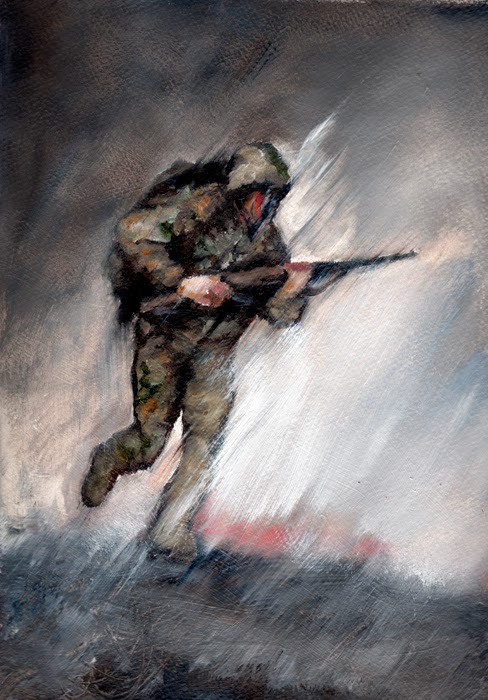
Here are a few of my military paintings that I have created showing our soldiers in the trenches. Some of these oil paintings I created for books, but most were personal images that I created showing the faces of war and the brave decisions our soldiers make to survive.

I think General Logan said it the best when he started the first Memorial Day after the Civil War. Gen. Logan’s order for his posts to decorate graves in 1868 “with the choicest flowers of springtime” urged: “We should guard their graves with sacred vigilance. ... Let pleasant paths invite the coming and going of reverent visitors and fond mourners. Let no neglect, no ravages of time, testify to the present or to the coming generations that we have forgotten as a people the cost of a free and undivided republic.”

Caniglia   


Friday, May 9, 2014

Meeting Simon Schama


Last night I had an opportunity to sit and talk with Simon Schama. He currently teaches at Columbia University in New York City. He is a prolific writer and brilliant historian. 
He just released his new book this year titled “The Story of the Jews” that was also made into a film series by PBS.

I was able to meet with Simon just before his lecture at the Des Moines Art Center. We talked about the artist Caravaggio as well as my son Caravaggio. We also discussed his series that he created called the “Power of Art” for PBS and his book “Rembrandt’s Eyes”. I strongly recommend reading these books and watching his PBS series.

What I came away with was inspiration beyond words. Simon is passionate, loud, ambitious and above all humble. He was so gracious, kind, warm, and intense. His knowledge of art history is unmatched. He has taught at Harvard, Cambridge, and Oxford and after talking with him I know why. 

I discussed my art and teaching with him and gave him a copy of my art book “I Before E except After Death” which made him smile. Schama understands art that doesn’t always fit the mold and for that I appreciate him even more.

His lecture later in the evening was about his latest book called “The Story of the Jews” and as Simon says, “It is a story like no other: an epic of endurance against destruction, of creativity in oppression, joy amidst grief, the affirmation of life against the steepest of odds.” 

Schama is a genius and will always be an inspiration to my work and me.

Caniglia   

(I would also like to thank Eric Salmon who took the photo)


Sunday, May 4, 2014

Caniglia - Anatomical Studies


Since I have been showing some of my old master studies I thought I would also show some of my scientific studies as well. As I have mentioned in several of my entries sketching is key to understanding an artist development both in ideas and in technique.

DaVinci of course knew this better than any other artist. We still have hundreds of his anatomical, medical, botany, and science drawings. They give us insight in our own lives and the world we live in. An artist commitment to science needs to be as strong as their commitment to art. If you understand the human form on all levels you will be able to render the form as you wish in your work.

As an instructor I am trying to make sure that my students have a firm foundation in the arts and sciences. They need to understand anatomy, botany, biology, physiology and parts of biophysics through art. Even if they don’t become medical illustrators they will have a starting place to develop characters for their own work in comics, movie concepts, or personal works.

These studies that I created are based off Netter’s medical illustrations. Frank Netter, M.D. (1906-1991) was one of the greatest artists in the field of medical illustration. Trained as a doctor, he began doing illustrations to clarify his understanding of anatomy. As he stated in his own words “I found that I could learn my subjects best by drawing," he said. His life work of more than 4,000 illustrations grew, “in response to the desires and requests of the medical profession.”

I used gouache, oil, and pen and ink to create these studies.

Caniglia   


Monday, April 21, 2014

More Ink Studies


I have a few pen and ink studies to show this week. These are quick drawings that I created based off the old masters. Why create master copies you might ask? It was the artist Ingres who said, “ Make copies, young man, many copies. You can only become a good artist by copying the masters.” Such artist as Leonardo, Raphael, and Degas did this type of training.

Over the last few weeks I have been looking at a lot of the old master drawings from Rembrandt to Michelangelo. As I survey the strength of their work I realize how effortless they make the line look, brilliant halftones and subtle shadows. It helps me understand and recognize what was going through the master’s head in hopes of understanding nature and anatomy as they did.

I have been doing master studies for years and I have found it strengthens my own work and helps me understand what I am trying to bring out in my own work. The subject matter is different but the strength of the line and composition is so important.

Thanks
Caniglia   


Sunday, April 13, 2014

INK DRAWINGS


Drawing is a fundamental skill in the design process and is the key tool that every artist must embrace to understand how light, form, and gradations work. As artist we train in several different media trying to represent complex three- dimensional forms, the paradigm of which is the human figure.

In my class demonstrations I reference the Old Masters and their dedication and devotion to understand the world in light and shadow Here are a few of my latest ink drawings using the techniques of the Old Masters. Sometimes I use sanguine pencil, the three- color pencil on toned paper technique known as trios crayons, and pen and brush (with ink and watercolor) wash sketching; the subjects always involve the figure, and trying to capture the essence of the form and the beauty of simple line work.

Thanks
Caniglia